

DIGITAL HACCP COMPLIANCE: MODERNISING FOOD SAFETY AND TRACEABILITY IN THE FOOD & BEVERAGE INDUSTRY

EXECUTIVE SUMMARY
Food safety incidents are still one of the most damaging risks for food and beverage businesses, both financially and in terms of consumer trust. HACCP has given the industry a powerful, preventive framework, but in many organizations it is still executed through paper forms, clipboards, and disconnected spreadsheets that were never designed for real‑time control or modern supply‑chain complexity. This gap between principle and practice is widening as regulators, retailers, and consumers demand stronger traceability, faster responses, and more transparent evidence that risks are under control.Food safety incidents are still one of the most damaging risks for food and beverage businesses, both financially and in terms of consumer trust. HACCP has given the industry a powerful, preventive framework, but in many organizations it is still executed through paper forms, clipboards, and disconnected spreadsheets that were never designed for real‑time control or modern supply‑chain complexity. This gap between principle and practice is widening as regulators, retailers, and consumers demand stronger traceability, faster responses, and more transparent evidence that risks are under control.
At the same time, a wave of digital technologies—IoT sensors, cloud platforms, and increasingly AI—has reached a level of maturity and affordability that makes data‑driven food safety a realistic option, not just for global brands but also for small and medium‑sized producers. Regulatory initiatives such as the FDA’s “New Era of Smarter Food Safety” signal a clear direction: food safety systems must become more digital, more interoperable, and more capable of using data to anticipate issues rather than just documenting them after the fact.
This white paper argues that the future of HACCP lies in combining its proven principles with digital food safety management systems, end‑to‑end traceability, and AI‑driven analytics. It explains why companies must comply with HACCP‑based regulations, how HACCP is implemented in practice today, and where manual, paper‑based approaches create blind spots, wasted effort, and unnecessary risk. It then explores how digital HACCP and food safety management systems centralize records, automate monitoring, and make audits faster and more reliable, while traceability solutions extend control upstream to suppliers and downstream to customers.
Building on this foundation, the paper describes the emerging role of AI in food safety: enhancing hazard analysis and HACCP design, enabling predictive risk assessment, supporting real‑time anomaly detection on the line, and helping teams generate and maintain compliant documentation at scale. It outlines the ecosystem of industries now providing solutions—from specialist food safety SaaS and enterprise quality platforms to industrial IoT and AI‑driven analytics providers—and shows how their offerings fit together. Finally, it sets out a “from vision to reality” pathway, highlighting the practical steps and cultural changes needed to move from paper‑based HACCP to digitally enabled, AI‑supported food safety that is both more effective and more efficient.
For boards, plant leaders, and quality professionals, the core message is that digital, AI‑enabled HACCP is not a distant future—it is already reshaping how leading organizations manage risk, demonstrate compliance, and compete. The strategic choice is not whether technology will transform food safety, but whether each organization will shape that transformation to its advantage.

INTRODUCTION
Food and beverage manufacturers today operate in an environment of unprecedented complexity. Globalized supply chains, evolving consumer expectations, and increasingly stringent regulations in the United States and Europe have raised the bar for food safety, quality, and transparency. At the center of this challenge is Hazard Analysis and Critical Control Points (HACCP): the preventive framework that underpins modern food safety management systems and certifications across the world.
For many organizations, however, HACCP remains a largely manual exercise—driven by paper checklists, spreadsheets, and isolated systems on the plant floor. This approach can satisfy basic audit requirements, but it struggles to keep pace with real‑time risks, complex product portfolios, and the need for rapid, well‑documented responses to incidents and recalls.
This white paper is written for quality, food safety, and operations leaders in the food and beverage sector who are responsible for protecting consumers, brands, and supply chains. Its purpose is to:
· Explain how HACCP emerged as the global reference model for food safety and why it remains essential today.
PURPOSE
· Describe how HACCP is typically implemented in modern plants—and where manual, paper-based methods fall short in a high-velocity, data-rich environment.
· Clarify the current regulatory and certification landscape, including Codex-based expectations, FSMA in the US, and GFSI-aligned schemes in Europe and beyond.
· Explore the emergence of digital HACCP and end-to-end traceability platforms, and the benefits they bring in terms of compliance, audit readiness, and operational performance.
· Highlight the growing role of artificial intelligence and advanced analytics in transforming HACCP from a static documentation exercise into a dynamic, predictive risk management system.

ORIGINS AND EVOLUTION OF HACCP
Imagine serving a meal where one mistake could cost lives and the mission—that was the food safety problem NASA faced when HACCP was born. In the early 1960s, NASA, the Pillsbury Company, and U.S. Army laboratories faced an unusual challenge: they needed food for astronauts that had effectively zero tolerance for safety failures, because a single contaminated meal in orbit could be catastrophic. Traditional quality control based on end‑product sampling and microbiological tests could not provide that level of assurance. Instead, the team adopted an engineering mindset, borrowing the idea of “critical control points” from reliability engineering to identify steps in the process.
This work led to the first version of what would later be called HACCP: a systematic approach to identifying potential hazards, determining which steps in the process were critical for controlling those hazards, setting limits at those steps, and monitoring them continuously. After NASA successfully used this methodology to supply safe food for space missions, Pillsbury applied similar thinking to its commercial operations, notably after a serious contamination issue in infant cereal highlighted the limits of conventional inspection and testing. In 1971, Pillsbury presented the HACCP concept publicly at the National Conference on Food Protection, marking the beginning of its journey from a specialized space‑program tool to a broader food industry practice.
Through the 1970s and 1980s, U.S. regulatory agencies began to adopt HACCP principles in specific sectors. The U.S. Food and Drug Administration (FDA) incorporated HACCP concepts into regulations for low‑acid canned foods, followed by mandatory HACCP requirements in seafood and juice processing, while the U.S. Department of Agriculture (USDA) introduced HACCP for meat and poultry plants. At the same time, influential scientific bodies such as the U.S. National Academy of Sciences recommended HACCP as a more effective approach to enhancing food safety across the food supply, reinforcing the shift from end‑product inspection to preventive process control.
The global turning point came when the Codex Alimentarius Commission, the joint FAO/WHO body for international food standards, incorporated HACCP principles into its General Principles of Food Hygiene. This gave HACCP a formal, internationally recognized structure, including the seven principles and application steps that are now widely known. Over the 1990s and 2000s, many countries and regions embedded HACCP‑based requirements into their food hygiene laws, and private schemes such as ISO 22000 and GFSI‑benchmarked standards integrated HACCP into comprehensive food safety management systems. In the European Union, for example, Regulation (EC) 852/2004 made procedures based on HACCP principles a legal obligation for most food businesses, reflecting the consensus that preventive, hazard‑focused control is the most effective way to protect consumers and support international trade.
Today, HACCP has evolved from a specialized tool developed for space travel into the backbone of modern food safety regulation, certification, and trade worldwide. The core idea—systematically identifying hazards and controlling them at critical points in the process—has remained constant, but the way HACCP is implemented continues to change as new technologies, standards, and expectations emerge. This evolution from NASA’s laboratories to global regulatory frameworks sets the context for understanding why HACCP systems are now the next logical step in that same trajectory of continuous improvement.

HACCP PRINCIPLES AND REGULATORY FRAMEWORK
At its core, HACCP is a structured, science‑based method for controlling food safety hazards throughout the entire food chain. Modern guidance from FAO/WHO and national regulators defines HACCP as a management system that identifies biological, chemical, and physical hazards, determines where they can be effectively controlled, and then establishes measures to prevent, eliminate, or reduce them to acceptable levels. The emphasis is on preventive control at specific points in the process, rather than relying only on end‑product inspection and finished‑goods testing.
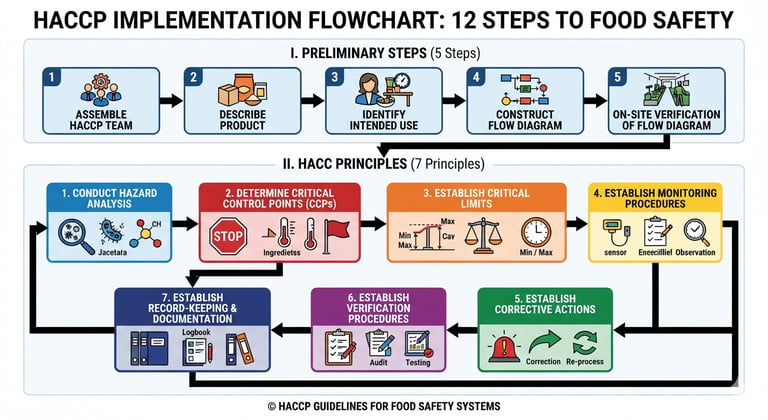
The HACCP framework rests on seven principles, which are applied following a set of preparatory steps (often described as 12 “application steps” in Codex and FAO guidance). The seven principles are:
Current international guidance stresses that HACCP should be built on strong prerequisite programs—such as Good Hygiene Practices (GHP), sanitation, pest control, equipment maintenance, and staff training—which handle general hygiene and environmental conditions. HACCP principles are then applied flexibly to the specific operation, product, and scale of the business, with Codex and FAO/WHO documents encouraging small and medium enterprises to adapt generic HACCP models to their context while still following the seven principles. In practice this means that HACCP is not a “standalone” system but a central component of broader food safety management systems that integrate hygiene, quality, and continuous improvement.
Conduct a hazard analysis (identify and evaluate potential hazards and select control measures).
Determine the critical control points (CCPs) where control is essential for safety.
Establish critical limits for each CCP (measurable criteria like time, temperature, pH).
Establish monitoring procedures to ensure CCPs remain within their limits.
Establish corrective actions to be taken when monitoring shows a deviation from a critical limit.
Establish verification procedures to confirm the HACCP system is working effectively.
Establish documentation and record‑keeping to demonstrate the design and ongoing operation of the system.
Over time, HACCP has become deeply embedded in the regulatory frameworks of major markets. In the United States, the FDA and USDA require HACCP‑based systems in sectors such as seafood, juice, and meat and poultry, and FSMA extends the preventive, hazard‑analysis approach into risk‑based preventive controls across many foods. In the European Union, general food hygiene legislation requires food business operators to implement and maintain procedures based on HACCP principles, making them a legal obligation for most food businesses. At the international level, Codex HACCP guidance serves as a benchmark for national regulations and for private certification schemes like ISO 22000 and GFSI‑benchmarked standards, which all incorporate HACCP within broader food safety management requirements.
This combination of clearly defined principles, supporting prerequisite programs, and strong anchoring in both public regulations and private standards explains why HACCP is widely described today as the global reference model for managing food safety risks. It also means that any modernization or digitalization effort in food safety—whether focused on the plant floor or the wider supply chain—must still demonstrate alignment with these seven principles and the regulatory expectations built around them.

WHY COMPANIES MUST COMPLY
For food and beverage manufacturers, HACCP is no longer a nice‑to‑have best practice; in most major markets it is the foundation of what regulators and customers expect. In the European Union, general food hygiene law requires food business operators to put in place, implement, and maintain permanent procedures based on HACCP principles for all stages under their control, from preparation and processing through packaging, storage, transport, and distribution. Similar expectations exist in the UK and many other jurisdictions, where food safety authorities explicitly state that every food business must have a documented food safety management system built on HACCP. In the United States, the FDA and USDA require HACCP plans in sectors such as meat, poultry, seafood, and juice, and the FSMA preventive controls rules extend the same hazard‑analysis and control logic to a broader range of human foods. When businesses do not comply, authorities can impose formal warnings, mandatory training, structural improvements, product seizures, and, in severe or repeated cases, financial penalties or closure of the operation.
Behind these legal requirements lies a clear public‑health rationale. Foodborne illness remains a significant burden, with millions of cases each year leading to hospitalizations, long‑term health issues, and deaths, and outbreaks repeatedly show how quickly pathogens like Salmonella, Listeria, or pathogenic E. coli can move through national and international supply chains. International organizations and regulators highlight that HACCP’s preventive, process‑based approach is the most effective way currently available to reduce such risks, because it forces companies to identify where hazards may arise, define critical limits (for example, cook temperatures, cooling profiles, or pH), and monitor those points systematically instead of relying mainly on end‑product sampling. By designing controls into the process and verifying that they work, companies can stop unsafe products before they leave the facility, which protects consumers and also reduces the need for large‑scale, reactive recalls.
Economic assessments of HACCP in meat and poultry plants help quantify the trade‑off between implementation costs and avoided losses. Analyses of the U.S. Pathogen Reduction/HACCP (PR/HACCP) program found that compliance raised production costs by roughly 1% on average—equivalent to fractions of a cent per pound of product—yet total program costs over 20 years were estimated at about 1.1–1.3 billion USD, while projected benefits from reduced foodborne illness ranged from 1.9 billion to more than 100 billion USD depending on the degree of pathogen reduction. In other words, even under conservative assumptions, the monetary value of fewer illnesses, lower medical costs, and avoided productivity losses outweighed the cost of implementing and maintaining HACCP. Additional economic work showed that HACCP compliance reduced the downside risk of large food safety losses at plant level, supporting the view that structured, preventive hazard control meaningfully lowers both the likelihood and the financial impact of major incidents.
Market dynamics further reinforce the need for robust HACCP systems. Large retailers, brand owners, and foodservice chains typically require suppliers to hold certifications against GFSI‑benchmarked standards, ISO 22000, or equivalent schemes, all of which are built around HACCP principles. Without demonstrable HACCP implementation and satisfactory audit results, manufacturers may struggle to access lucrative private‑label contracts or export markets. At the same time, consumers are more aware of food safety issues, and studies show that companies perceived as managing food safety proactively can differentiate themselves, maintain trust during incidents, and recover faster from crises. In this sense, HACCP functions as both a regulatory requirement and a commercial “passport” that enables participation in high‑value supply chains and long‑term customer relationships.
Internally, a well‑designed HACCP system also delivers day‑to‑day operational benefits that go beyond compliance. The process of mapping product flows, identifying hazards, and defining CCPs often reveals inefficiencies, unclear responsibilities, and inconsistent practices, which can then be addressed through clearer procedures and better training. HACCP‑based monitoring and corrective‑action processes help teams understand how the process behaves under normal and abnormal conditions, improving process stability, reducing rework and waste, and sometimes extending shelf life through tighter control of key parameters. When integrated with broader quality and continuous‑improvement programs, HACCP becomes part of a culture where food safety, quality, and efficiency reinforce each other rather than competing priorities. That is why many businesses that initially implemented HACCP to satisfy regulators or customers now view it as a strategic capability that protects their brand, supports profitable growth, and underpins their license to operate.

HOW HACCP WORKS ON THE FACTORY FLOOR
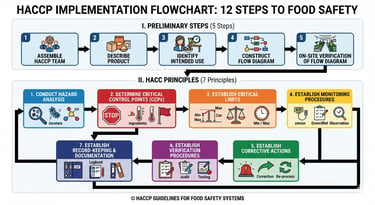
In day‑to‑day operations, implementing HACCP means translating the seven principles into a series of practical steps that fit a specific product and factory. Guidance from Codex, FAO/WHO, and national authorities often describes a 12‑step application process that starts long before any CCP is selected. Typical implementations begin by assembling a multidisciplinary HACCP team with experts from production, quality, maintenance, and sometimes procurement, who together describe the product, define its intended use, and construct a detailed process flow diagram from raw material receipt through processing, packaging, storage, and distribution. This flow diagram is then verified on the factory floor to ensure it accurately reflects reality, because any errors at this stage will undermine the entire hazard analysis.
Once the flow is confirmed, the team conducts a structured hazard analysis at each step of the process, considering potential biological, chemical, and physical hazards, their likelihood and severity, and existing control measures. Based on this analysis, they determine which steps are Critical Control Points (CCPs) where control is essential for safety, and they establish critical limits for each CCP—for example, minimum cook temperatures, maximum cooling times, or metal detector sensitivity thresholds. Monitoring procedures are then defined to ensure CCPs stay within those limits (who measures, what instrument is used, how often, and how results are recorded), along with predefined corrective actions that must be taken when a deviation occurs. Verification activities, such as internal audits, finished‑product testing, and review of records, are specified to confirm the HACCP system is effective, and comprehensive documentation is created to capture the plan, procedures, and records required for inspections and certification.
In practice, however, there is a wide range in how this framework is executed on the plant floor. Many food businesses, especially small and medium enterprises, still rely heavily on paper forms, clipboards, and spreadsheets to record CCP checks, deviations, and corrective actions, with data later filed in binders for auditors. Larger or more advanced manufacturers increasingly use a mix of tools: some monitoring points (such as temperatures or metal detection events) are captured automatically through data loggers, SCADA systems, or PLCs, while others (such as visual inspections, label checks, or sanitation verifications) are recorded on paper or basic digital checklists. This hybrid reality means that, although HACCP principles are widely adopted, information is often fragmented across systems and formats, making it difficult to perform real‑time analysis, trend deviations across lines and sites, or quickly assemble complete evidence for a regulator or customer.
For many organizations, maintaining HACCP therefore becomes a labor‑intensive documentation task rather than a fully integrated, data‑driven process control system. Internal and external audits frequently highlight issues such as incomplete records, unclear corrective‑action documentation, or HACCP plans that have not been updated as products, equipment, or suppliers change. At the same time, manufacturers that have invested in more digital HACCP and food safety management systems report benefits such as easier access to records, faster incident investigation, and better visibility across plants. This gap between the theoretical model and the operational reality is a key driver for the current wave of digitization and AI‑enabled tools that aim to make HACCP more reliable, efficient, and proactive.
DIGITAL HACCP AND FOOD SAFETY MANAGEMENT SYSTEMS
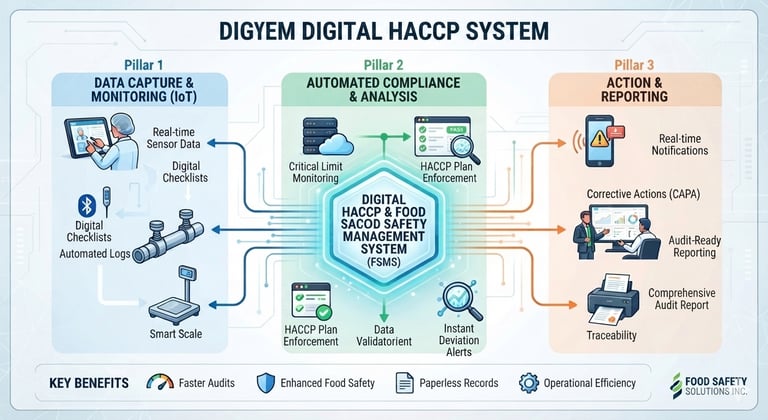
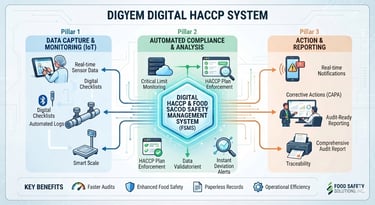
Over the last decade, many food and beverage manufacturers have begun to replace paper‑based HACCP records with digital food safety management systems (FSMS). These platforms aim to centralize HACCP plans, automate CCP monitoring, and streamline documentation so that food safety becomes a real‑time, data‑driven process rather than a retrospective paperwork exercise. In a typical deployment, the digital system stores the HACCP plan, links each CCP to a monitoring method, and provides operators with guided workflows—often via mobile or tablet apps—for completing checks, recording results, and documenting corrective actions. At the same time, sensors, data loggers, or SCADA/PLC integrations capture time‑temperature and other parameters automatically, feeding them into a central database instead of relying on manual readings.
Modern HACCP and FSMS software usually combines several functional layers. At the data capture layer, wireless temperature sensors, production equipment, and handheld devices collect measurements and inspection results in real time. A workflow and rules engine then compares these inputs against defined critical limits and procedural requirements, triggering alerts when values move out of range or when required checks are missed. On top of this, a document and record management layer maintains time‑stamped, tamper‑resistant logs of monitoring activities, deviations, and Corrective and Preventive Action (CAPA), ensuring that electronic records and digital signatures meet regulatory and audit expectations. Finally, a reporting and analytics layer aggregates data into dashboards and reports for managers, enabling trend analysis by line, shift, site, product, and supplier.
The benefits reported by companies adopting digital HACCP and FSMS are both compliance‑related and operational. Digital systems significantly reduce the time spent on manual record‑keeping and document retrieval, making it easier to prepare for inspections and customer audits and to demonstrate continuous compliance with HACCP‑based regulations. Real‑time monitoring and automated alerts provide earlier warning of deviations, helping teams intervene before small issues escalate into major non‑conformances or product losses. Centralizing data across multiple sites gives corporate food safety and quality leaders better visibility into recurring problems, allowing them to identify systemic root causes, update HACCP plans, and improve training and procedures. In parallel, case studies from sectors such as seafood, poultry, and dairy show that layering digital monitoring and analytics on top of HACCP can reduce incidents linked to temperature abuse and other critical parameters, while also supporting predictive maintenance and more efficient resource use.
The market has responded to this need with a growing ecosystem of HACCP and food safety software providers. Commercial solutions range from focused “HACCP apps” that digitize checklists and logs to comprehensive FSMS/QMS platforms that combine HACCP, prerequisite programs, supplier management, document control, and CAPA into a single cloud service. Analysts estimate that the food safety HACCP software market is growing at double‑digit compound annual rates, driven by stricter regulations, retailer and brand owner expectations, and the search for more efficient ways to manage food safety risk across complex supply chains. The direction of travel is clear: regulators and customers still expect full alignment with HACCP principles, but they increasingly assume that this will be supported by robust electronic systems that provide traceable, auditable, and analyzable data rather than stacks of paper.

TRACEABILITY AND SUPPLY-CHAIN QUALITY
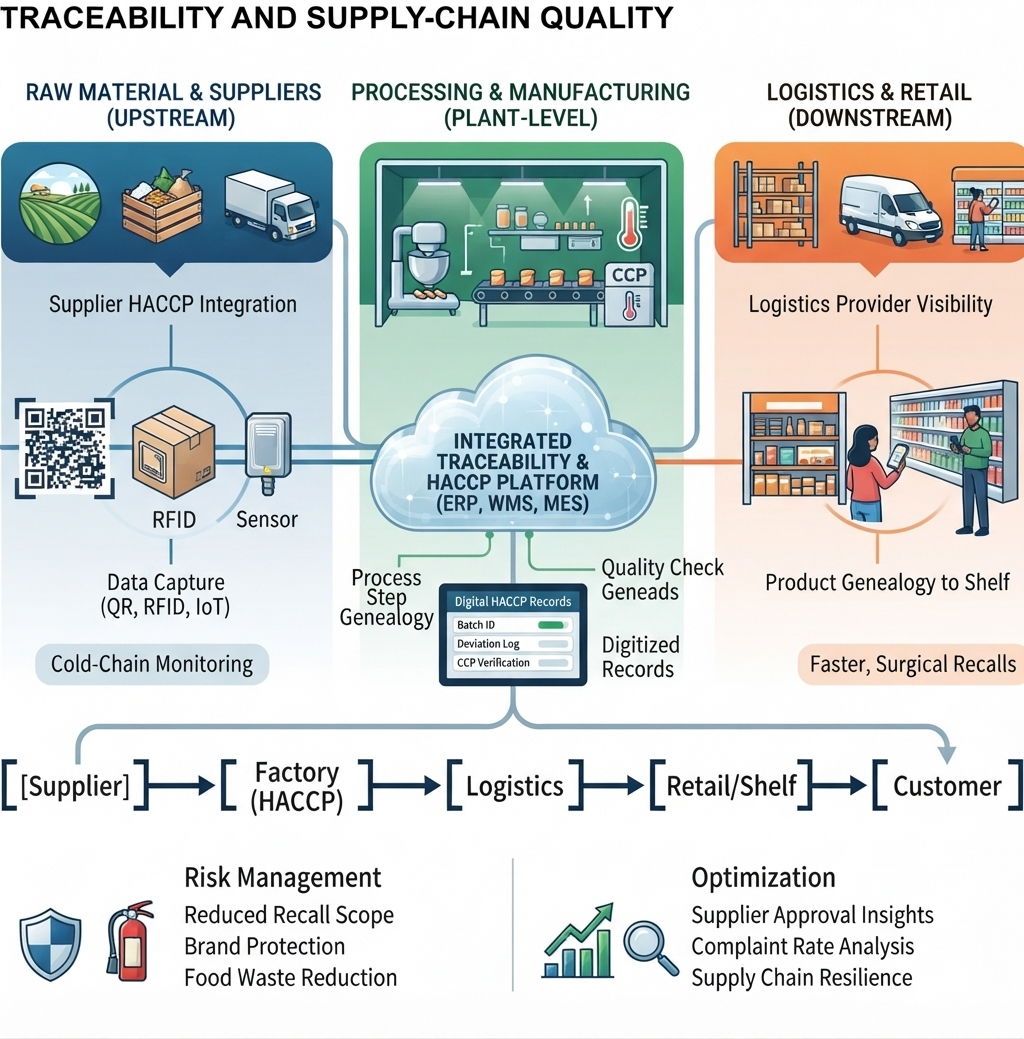
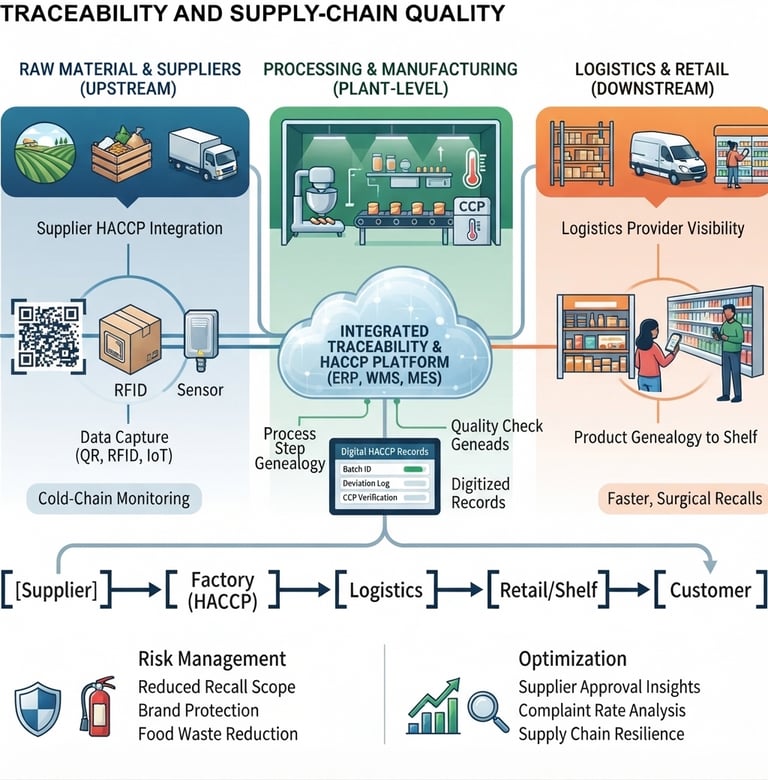
Modern food safety risk does not stop at the factory gate; it starts with raw materials and extends through copackers, logistics providers, and retailers. Traceability systems connect data across this chain, linking each batch of raw materials, process step, and finished product to a unique identity that can be followed from source to shelf. For HACCP‑based systems, this upstream and downstream visibility is critical: many of the most serious incidents originate from supplier failures, contamination in ingredients, or cold‑chain breaks during storage and transport that HACCP alone, focused on the plant, cannot fully control.
From a quality and safety standpoint, traceability enables faster, more surgical responses when something goes wrong. By knowing exactly which lots of finished product contain a suspect ingredient, and where those lots were shipped, companies can narrow the scope of recalls and withdrawals rather than pulling entire production days or product families. This not only reduces direct recall costs but also limits brand damage and food waste, while helping regulators and customers see that the company has robust controls and documentation in place. At the same time, tracing data across suppliers and lanes allows quality and procurement teams to spot patterns—such as higher defect or complaint rates associated with specific sources, routes, or partners—and feed those insights back into supplier approval, specifications, and HACCP reviews.
Digitally, this means extending your HACCP and FSMS platform beyond the four walls of the factory. Barcode, QR, RFID, and IoT technologies can automatically capture product identity, location, and condition at key handover points, with events stored in a centralized system that integrates with ERP, WMS, and MES. Combining this with digital HACCP records allows companies to reconstruct a full “genealogy” for any batch—what raw materials were used, which CCP checks were performed, which deviations occurred, and which customers received the product—within minutes instead of days of manual searching in binders and spreadsheets. This integration of plant‑level HACCP, supplier quality, and logistics traceability is increasingly seen as a prerequisite for resilient, transparent supply chains, not just an optional add‑on.

WHY DIGITIZATION IS NEEDED
In many food businesses, HACCP still lives on clipboards, binders, and spreadsheets. On a good day, this works; checks get done, logs are filled, and audits pass. But underneath, paper systems have built‑in blind spots: checks are sometimes done late and written in later, critical deviations can sit unnoticed on a sheet in a folder, and managers only see the full picture weeks or months after the fact. Research and industry experience show that in busy, complex operations a significant share of scheduled HACCP tasks are completed late or not at all when managed manually—not because people don’t care, but because the system itself makes it easy for things to slip. As long as food safety depends on memory, handwriting, and manual filing, the risk of gaps, errors, and missing evidence is always there.
Paper also works against one of HACCP’s core ideas: being proactive, not reactive. If a fridge runs at 8°C instead of 4°C, a paper log usually only reveals the problem when someone reviews it later—by which time the product might already have been processed, shipped, or served. There are no automatic alerts, no escalating notifications, and no way to see patterns, such as a chiller that keeps drifting warm on night shift or a line that regularly misses metal detector checks during peak hours. Turning hundreds of sheets into insight is so time‑consuming that most teams simply don’t do it; they file the records “for the auditor” and move on. This means that HACCP, which was designed as a live, dynamic risk‑management tool, ends up acting more like a static archive.
Digitization flips that logic. Digital food safety systems capture data in real time—through mobile apps, connected thermometers, equipment integrations, and automated schedules—and compare it instantly against critical limits and monitoring plans. If a check is missed, the system reminds the operator; if a value is out of range, it raises an alert and guides the team through the right corrective action, recording every step with timestamps and user IDs. Because data is stored centrally and securely, it cannot be quietly changed after the event, and it can be backed up and searched in seconds, even if a site experiences a fire, flood, or simple loss of paperwork. Instead of spending hours chasing missing forms, managers can see dashboards that highlight where risk is increasing today—by line, shift, product, or supplier—and act before issues turn into recalls or enforcement actions.
Beyond basic compliance, digitization is increasingly a strategic necessity. Global supply chains, stricter regulations, and demanding retailers all expect robust, traceable, trustworthy data, not just “we think we did the checks.” Digital records make audits faster and less stressful, because months of evidence can be pulled up in minutes and filtered by date, product, or CCP instead of searching through boxes of paper. They also unlock new capabilities—like automatically tracing suspect batches back through ingredients and routes, or using analytics and AI to spot emerging risks—that are effectively impossible with paper. In this environment, plants that remain paper‑based find themselves spending more time on low‑value admin and still receiving findings for documentation gaps, while digital plants turn the same data into better decisions, leaner operations, and stronger trust with customers and regulators.
Taken together, this is why digitization is no longer just “modernization” but a requirement for a credible HACCP and food safety program. The core principles of HACCP do not change, but the way they are executed must adapt to the speed, complexity, and scrutiny of today’s food system—and only digital systems can provide the visibility, integrity, and responsiveness that this reality demands.

ROLE OF AI IN HACCP AND FOOD SAFETY
Digitization turns paper into data; AI turns that data into foresight. Once HACCP and food safety records are captured digitally—temperatures, CCP results, deviations, supplier data, complaints, lab results—AI and machine learning models can start to learn patterns that humans cannot reliably see in spreadsheets or binders. Technical bodies and recent reviews describe AI as a way to build “virtual laboratories” and risk models that combine information from many different sources to support safer, faster decisions in complex food systems. Instead of only asking “did we meet the critical limit at this check?,” AI‑enabled systems can ask “where is risk building up across our process, our suppliers, and our network—today and in the weeks ahead?”.
One of the clearest applications is predictive risk and HACCP optimization. By training on historical data—such as contamination incidents, temperature logs, equipment failures, and seasonal trends—machine learning models can identify combinations of factors that tend to precede problems, and assign risk scores to products, lines, or shifts in real time. This can support HACCP teams in several ways: highlighting steps in the process where hazards are more likely than originally assumed, suggesting which CCPs are truly critical and which controls might be redundant, and helping prioritize monitoring and verification resources. AI‑driven platforms are already being used to enhance HACCP plans by scanning global incident data and supplier histories to flag emerging hazards and vulnerable ingredients so that companies can update their plans before issues hit their own plants. In practice, this shifts HACCP from a static document reviewed once a year into a living, data‑driven system that continuously adapts to new risks.
AI also changes how monitoring and inspections happen. Computer vision models can analyze images and video from cameras on production lines to detect foreign bodies, damaged packaging, label errors, or visible hygiene deviations at speeds and consistency far beyond human inspectors. Machine learning applied to sensor data can spot subtle anomalies in refrigeration, cooking, or cleaning‑in‑place (CIP) patterns that indicate an emerging failure, allowing maintenance or process adjustments before a critical limit is breached or a batch is lost. Studies and industry deployments show that these AI‑based systems can support real‑time decision‑making, automate parts of visual inspection, and reduce the chances that contaminated or substandard products reach consumers. In a HACCP context, this means AI is not replacing CCP checks, but acting as an extra “pair of eyes and brain” that makes monitoring more sensitive, continuous, and reliable.
Upstream and downstream, AI enhances traceability and supply‑chain safety. Risk‑intelligence platforms use AI to scan public recalls, scientific reports, and trade data to identify emerging risks—such as rising incidents of a pathogen in a particular commodity or region—and map how those risks might propagate through supply networks. By combining this with a company’s own purchasing and quality data, AI can rank suppliers, ingredients, or routes according to their current risk profile and recommend where tighter controls, additional testing, or alternative sourcing may be needed. During an incident, AI‑enabled traceability engines can traverse large, complex datasets of batch movements, transformations, and customers to rapidly identify the smallest set of lots that must be recalled, minimizing cost and time to respond. This kind of intelligence extends HACCP thinking beyond the plant into the whole “farm to fork” chain.
Finally, AI can simplify the work of building and maintaining compliance itself. Emerging tools use natural language processing and expert models to help teams assemble HACCP plans, suggest hazards and controls based on product and process descriptions, and generate structured documentation aligned with regulatory and GFSI expectations. AI assistants can answer frontline questions about procedures, guide staff through corrective actions, and automatically generate audit‑ready reports from raw data without manual cutting and pasting. Regulators and technical experts emphasize that responsibility always stays with human professionals, but properly designed AI tools can reduce repetitive workload, support consistency, and allow scarce food safety experts to focus more on judgment and coaching and less on paperwork.
In that sense, the role of AI in HACCP is not to replace the principles, but to amplify them: the same seven principles, executed with millions of data points, predictive models, and intelligent assistance instead of clipboards and retrospective reviews.

WHICH INDUSTRIES ARE PROVIDING SOLUTIONS
The shift from paper HACCP to digital, AI‑enabled food safety is not being driven by food manufacturers alone. A whole ecosystem of industries is now providing solutions that sit on top of, alongside, or inside existing HACCP and food safety programs. Understanding who these players are helps explain why digitization is accelerating and where innovation is coming from.
First, the specialist food safety and HACCP software sector has grown rapidly. These are SaaS providers that focus almost entirely on digital HACCP, electronic checklists, automated temperature monitoring, audit trails, and traceability across the food supply chain. Their customers range from single‑site restaurants and dark kitchens through to multi‑site manufacturers and retailers, and their products typically combine mobile apps for frontline checks, cloud dashboards for QA and operations teams, and integrations to sensors and existing ERPs.
Second, enterprise quality and compliance platforms from the broader life‑sciences and regulated‑industries world are moving into food and beverage. These vendors historically served pharmaceuticals, medical devices, or general manufacturing with quality management systems, and are now adding dedicated digital HACCP modules and food‑specific workflows. Their strengths lie in robust document control, CAPA, audit management, and integration of HACCP with wider quality, safety, and regulatory processes across global organizations. This makes them attractive to large brands that want a unified view of quality from plant floor to corporate.
Third, industrial technology and IoT companies provide the hardware and connectivity that make digital HACCP possible. Suppliers of wireless temperature sensors, refrigeration monitoring, production‑line inspection systems, and store‑level IoT devices now package their offerings as “digital food safety” or “digital HACCP” solutions, often including cloud portals and alerting tools. These systems continuously capture cold‑chain and process data, push automatic alerts when conditions drift out of spec, and feed structured data into HACCP and FSMS platforms for analysis and auditability.
Finally, a new wave of AI and data‑analytics providers is emerging specifically for food safety and supply‑chain risk. These companies focus on ingesting large volumes of operational data (sensors, CCP records, complaints, lab tests) plus external information (recalls, scientific alerts, trade data) to provide predictive risk scoring, intelligent HACCP plan support, and automated documentation. Some position themselves as “AI assistants for food safety compliance”, helping teams build and maintain HACCP plans, while others concentrate on predictive analytics and anomaly detection to prevent issues before they trigger a recall.
Together, these industries form the backbone of the digital HACCP and food safety landscape: specialist food safety SaaS, enterprise quality platforms, industrial IoT and monitoring providers, and AI‑driven analytics and compliance tools.v

FROM VISION TO REALITY
Up to this point, the story has been about why: why HACCP matters, why digitization is needed, and how AI can transform food safety. Turning that vision into reality inside a factory or a food business, however, is not just a technology problem. It is a change‑management problem that touches people, process, and data all at once. Experience from digital food safety projects shows that many initiatives fail not because the tools are weak, but because they are dropped onto existing ways of working without a clear path from today’s paper‑heavy reality to tomorrow’s connected, data‑driven system.
The starting point is a clear, shared picture of “today”. Successful companies begin by mapping their current HACCP and food safety workflow: which forms and logs exist, where data is captured, who signs off, where delays and rework happen, and which parts actually work well and should not be disrupted. This diagnostic step often reveals duplicate records, gaps between departments, or manual “patches” added over time to satisfy audits, and it turns the abstract idea of “digital transformation” into a concrete list of pain points and priorities. From there, organizations can define a practical target state—what they want the system to look like in three years in terms of visibility, automation, audit readiness, and integration with existing ERP, MES, or quality platforms.
The next move is to start small but design for scale. Rather than trying to digitize every record on day one, many food businesses focus first on high‑risk, high‑pain areas such as refrigeration control, cook/chill steps, or allergen management, and run digital and paper systems in parallel briefly to build confidence. During this phase, they validate that digital records are accurate, that alerts and workflows behave as expected, and that auditors accept the new evidence. Quick wins—faster checks, fewer missing logs, easier prep for an inspection—help build momentum and justify extending the system to more processes, more sites, and eventually to supplier and logistics traceability.
Critically, the transition succeeds only if people come with it. Studies of digital transformation in food manufacturing highlight management commitment, staff involvement, and targeted training as make‑or‑break factors for sustainability. Frontline teams need tools that fit their daily reality—simple, mobile, and robust—plus “super users” on the floor who can support colleagues and give feedback to continuously improve workflows. At the same time, leadership must align metrics and incentives so that using digital HACCP and acting on its insights is seen as part of how the business runs, not as an extra compliance chore.
When these elements line up—honest baseline, focused initial scope, scalable architecture, and engaged people—the vision described earlier in the white paper stops being futuristic and becomes operational: real‑time visibility into CCPs, predictive risk alerts, integrated traceability, and AI‑assisted HACCP decisions embedded in daily work. That is what “from vision to reality” looks like in a modern food safety program: not a one‑off IT project, but a staged, deliberate shift in how hazards are controlled, decisions are made, and trust is earned across the supply chain.